|

Myers...Since 1884
|
|

Health,
Safety & Environmental Compliance Program
B.L.
Myers Bros. has been in business since 1884 and has
weathered the storm of changing regulations, new
environmental laws, and numerous mandatory increases in
workplace safety. Customers today often have difficulty
clearing the hurdles to HSE compliance and we have heard
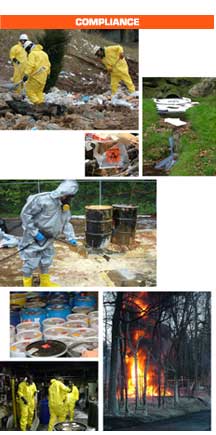
the call for help. Whether your needs exist in the field
with employee training, safety audits, or command of
hazardous materials releases or in the office with
program development, program audits or risk management
assistance, B.L. Myers can provide you the professional
experience you seek.
Our
health, safety and environmental compliance program is
directed by Michael D. Cassella, CET. A certified
health, safety & environment trainer (CET) and
ExxonMobil authorized loss prevention systems (LPS)
trainer, Mr. Cassella has over 20 years experience
servicing consultants, contractors, engineering firms
and manufacturing facilities throughout the U.S.
Credentials for Michael include:
-
Development and implementation of regulatory safety
programs.
-
Professional trainer with over 8,000 hours of
instruction in OSHA, DOT, EPA, Emergency Response,
and numerous company/client specific programs.
-
Management of workers compensation program, which
includes; claims submission and management,
litigation, surveillance, and employee return to
work program.
-
Training and command of hazardous materials response
team.
-
Use
and application of direct and indirect reading
monitoring instruments including a photo-ionizing
detector (PID), explosive gas/oxygen meters, mercury
vapor analyzer, and flame ionizing detector (FID)
colorimetric tubes.
Health & Safety Services include
Training: Open enrollment course at our facility
--
Hazardous waster operations &
emergency response (HAZWOPER)
OSHA 29 CFR 1910.120
Emergency Response for Hazardous Materials (HAZMAT)
Awareness Level: designed for employees who may
encounter a hazmat spill and are required to initiate an
emergency response.
Operations Level: Initial response in a defensive
fashion.
Hazmat
technician: The hands-on response to chemical
releases.
Incident Command: This course is designed to prepare
individuals to take charge of a hazardous materials
response. |
|
Training programs: customized on-site
Bloodborne Pathogens 1910.1030: Are your employees at
risk of exposure to hepatitis, aids, and infectious
disease?
This
course identifies those at risk, the methods of
protection, job responsibilities and routes of exposure.
Confined Space Entry 1910.146: According to OSHA, if
any part of your body breaks the plane of a confined
space, you have just made an entry. The course outlines
the requirements of the standard, explains use of PPE,
and identifies those hazards associated with confined
spaces.
Fire
Extinguishers 1910.157: Are your employees really
prepared to extinguish an incipient fire at your
facility? Students are provided the opportunity to
extinguish a controlled fire in a training environment.
Forktrucks (Powered Industrial Trucks) 1910.178: The
regulation requires employers to certify their operators
on the forktrucks in your workplace. This training is
customized to your equipment and provides a three-year
certification to class participants.
Hazard Communication (Hazcom) 1910.1200: This is the
number 1 most cited OSHA violation. Employers are
responsible for identifying work place hazards; provide
material safety data sheets (MSDS) and relay the
information to the effected employees.
Hearing Conservation (Occupational Noise Exposure)
1910.95: Discuss the sources and hazard of occupational
noise, engineering controls, PPE, and the hazards of
excessive noise.
Lockout & Tagout (Control of Energized Systems)
1910.147: Identifies those process and systems the
store hazardous energy and those methods that your
employees must know to protect themselves.
Personal Protective Equipment 1910.132 through 139:
This course explains what those requirements are and
when they apply. Students learn how to identify
hazards, how to choose PPE, its limitations, use, and
care.
Respiratory Protection 1910.136: Breathing easy is the
focus of this course. It identifies the potential
airborne hazards, monitoring, respirators, their
limitations and the medical monitoring requirements
associated with respiratory protection.
Construction: OSHA 29 CFR 1926 select topics (Competent
Person Certification)
Excavations 1926.650 Subpart P: Provides competent
person training required for excavation and trenching
practices. Includes soil classification, protective
systems, and the regulatory requirements of the
standard.
Fall
Protection 1926.500 Subpart M: Identifies the use and
applications of fall protection devices, areas where
fall protection is required, and associated hazards.
______________________________
For more information on B.L. Myers HSE services, contact
Michael Cassella, Health & Safety Manager at
mcassella@blmyers.com or 610-942-2030 ext. 233.
|